No products in the cart.

Description
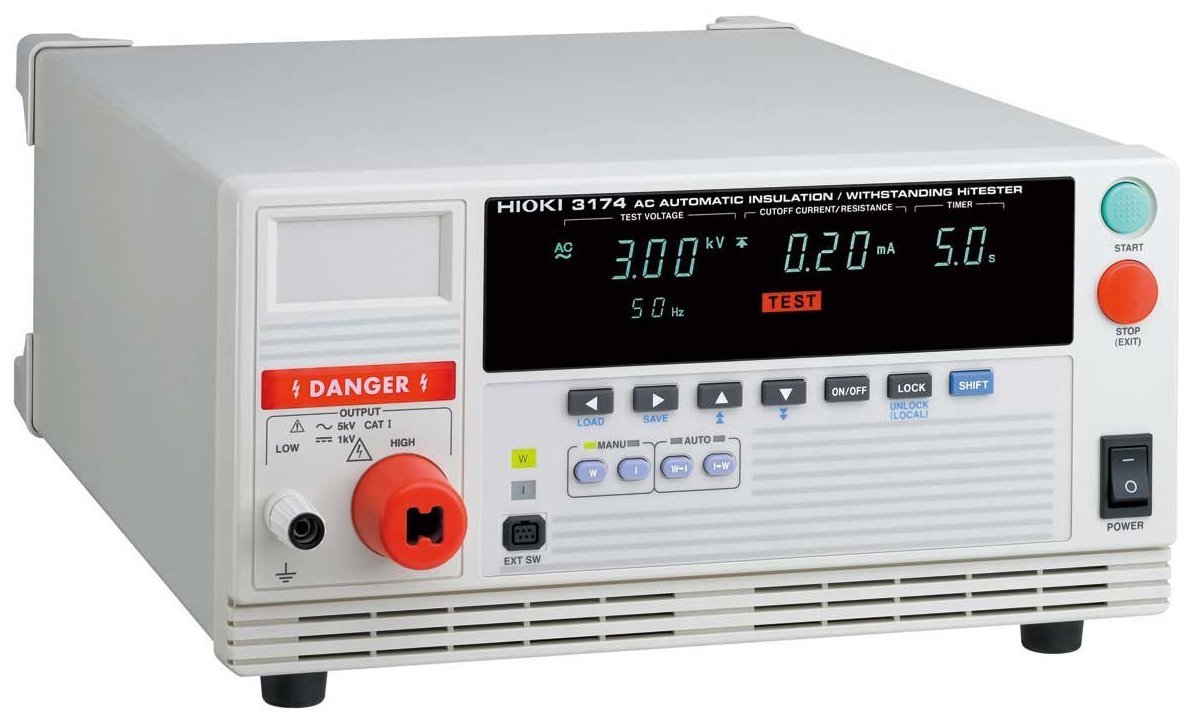
Hioki 3174 AC Automatic Insulation/Withstanding Tester

3174 AC Automatic Insulation/Withstanding TesterContinuous testing of insulation (500/1000 V) and withstand voltage (100 VA transformer capacity)Full remote operation when used in combination with the Safety Test Data Management Software 9267
Inaccuracies in measurements have been noted to occur during the withstandvoltage and insulation-resistance tests because of variations in the test voltage caused by fluctuations in the voltage supply, breaking of the test leads and improper connection.Model 3174, 3174-01 AC Automatic Insulation/Withstanding HiTester is an affordable insulation/withstanding testing instrument equipped with stable voltage supply and contact check functions to prevent a decrease in testing reliability caused by these factors.In addition, to improve the efficiency of the testing process on the production line, it allows testing settings to be retrieved from both RS-232C (GP-IB) as well as EXT I/O.
Improved Test Reliability
- Contact check function improves test reliability
The 3174’s contact check function lets you detect test lead wire breaks and faulty contact during testing by sensing measurement issues in real time.

- If a test lead were to come lose during testing with a measurement device that does not offer contact check functionality, defective test pieces would be judged to be non-defective.
The 3174 improves test reliability by monitoring voltage to detect lose leads during testing and faulty wiring during measurement.
*Since contact check is performed while testing is in progress, use of contact check functionality does not increase cycle time.
- If a test lead wire were to break during testing with a tester that does not offer contact check functionality, defective test pieces would be judged to be non-defective.

Safety Testing / Surge Testing/Hipot Tester Template | |
|---|---|
| Test Type Hipot | AC, IR |
| Max AC Test Voltage | 5 kV |
| Min AC Test Voltage | 0.2 kV (200 V) |
| Programmable (hipot) | No |
| Insulation Resistance Test | Yes |
| IR Test Voltage | 1,000 V, 10 V, 100 V, 2,000 V, 2,500 V, 25V, 400V, 5,000 V |
| Connection Type | Probe |
| Maximum Insulation Resistance | 2000 M Ohms |
Product General Attributes | |
| Product Weight | 15 KILOS (33.07 LBS) |
| Product Height | 155 MM (6.10 IN) |
| Product Length | 395 MM (15.55 IN) |
| Product Width | 320 MM (12.60 IN) |
| Data Logging | No |
| ECCN Number | 3A992 |
| Power Supply Voltage | 120V/220V Universal |
| Country of Origin | Japan |
| Other Information | Output voltage: 0.2 to 5 kV AC (50/60 Hz), Single range output Output frequency: 50/60 Hz, ?0.2% Voltage output method: PWM switching (0 V start, Voltage change during supply possible) Voltage setting method: Digital setting, Setting resolution: 0.01 kV Output voltage accuracy: ?1.5% of the setting value ?20 V Maximum rated power: 100 VA AC (5 kV/20 mA), continuous Transformer capacity: 100 VA Output waveform: Sine wave Fluctuation rate: 15% or less (At Maximum rated load ? no load converge to set value within 1 second) Distortion rate: 5% or less (At 40 MO, load 5 kV output: impedance of measuring device during measurement) Voltage measurement: True RMS indication Current measurement range: 0.01 mA to 20 mA (2-range structure) Designated value: True RMS indication Measurement range: 10 mA/20 mA Measured area and resolution: 0.00 mA to 9.99 mA, 0.01 mA (10-mA range) Measurement accuracy: ?2%rdg ?0.05 mA (10-mA range) Decision Function Decision contents: UPPER FAIL : when measured current exceeds the upper-limit setting Decision process: Output to the display, beeper sound, signals to EXT I/O for each decision result Setting range: AC: 0.1 to 20.0 mA (Upper-limit value), 0.1 to 19.9 mA (Lower-limit value), Setting resolution: 0.1 mA Rated supply: 500 V/1000 V DC (positive electrode) No load voltage: 1 to 1.2 times of rated voltage Voltage measurement: Digital meter, 0 to 1000 V DC Insulation resistance, Accuracy ?30 V Rated measurement current: 1 to 1.2 mA Short-circuit current: 4 to 5 mA (500 V), 2 to 3 mA (1000 V) Measurement range: 0.2 M to 2000 MO (500 V), 0.5 M to 2000 MO (1000 V) Accuracy guarantee: 0.5 M to 999 MO (500 V), 1 MO to 999 MO (1000 V): ?4%rdg 1000 MO to 2000 MO: ?8%rd Measured resolution: 0.01 MO (0.20 MO to 19.99 MO) Measurement resistance range: 2 MO, 20 MO, 200 MO, 2000 MO (500 V) Decision method: Window comparator method (digital setting) Decision contents: UPPER FAIL : When measured resistance exceeds the upper-limit setting. Decision process: Output to the display, beeper sound, signals to EXT I/O for each decision result Setting resolution: 0.01 MO (0.2 to 2.00 MO) Setting range: 0.3 to 999 s Operation: At ON Setting : Displays the time that is counted down from the start Setting resolution: 0.1 s: 0.3 to 99.9 s, 1 s: 100 to 999 s Accuracy: 0.3 to 99.9 s: ?50 ms, 100 to 999 s: ?0.5 s Setting range: 0.1 to 99.9 s, The ramp-up time and ramp-down time can be set individually. Operation: Ramp-up : Using ramp-up time from initial voltage to test voltage to increase the output voltage gradually Setting resolution: 0.1 s Accuracy: ?50 ms Delay timer: (Withstand-voltage test) Setting range: 0.1 to 99.9 s Setting resolution: 0.1 s Accuracy: ?50 ms Power supply: Internal power supply Between ISO_DCV-ISO_COM: 15 V?0.5 V, 100 mA (total) Signal level: All signals Active LOW Output signals: Open collector output, (insulated with a photocoupler), All signals Active LOW Maximum load voltage: 30 V DC Maximum output current: 100 mA DC/ For 1 signal Output saturation voltage: 1.5 V DC or less Signal names: H.V.ON : Generating voltage for output Input signals: All Active LOW inputs (insulated with a photocoupler) Maximum input voltage: 30 V DC HIGH level voltage: Above 15 V below 30 V DC or open LOW level voltage: 5 V DC or less (-6 mA typ.) Signal names: START : Test start Input signal (contact input): START, STOP, SW.EN (External Switch Terminal valid) Output signal: LED light signal (40 mA max. load current) Priority placings for Key input: RS-232C Remote control box EXT I/O Front panel of the 3174 (3174- 01) (When START setting is valid with RS-232C) (Only START. STOP, Interlock are valid and all have the same level of priority regardless of the condition of EXT_E)) Synchronization method: Start-stop synchronization, full duplex Transfer rate: 9600 bps/ 19200 bps Data length: 8 bits Stop bit: 1bit Hand shake: No X flow, hardware flow control Delimiter: Receiving : CR, CR+LF Command structure: Reference standard: IEEE 488.2-1987 (3174-01) Memory function: This function allows test conditions to be saved. Memory contents: Withstand-voltage test mode test-voltage type (AC50/60 Hz), test-voltage, upper (lower)-limit current evaluation values, test-time, ramp-up (down) time, initial voltage for ramp-up, upper (lower)-limit for Contact Check voltage (Both upper-limit and lower-limit values can be set) Memory space: 8 sets each for withstand and insulation (save, load possible) Pass hold function: Enable this function to hold the Pass state when detected, to facilitate confirmation. Fail hold function: Enable this function to hold the Fail state when detected, to facilitate confirmation. Hold function: Maintains the measurement value obtained at the end of a test Buzzer settings: Buzzer volume settings for test screening and errors (buzzer volume settings are to be performed for PASS and FAIL separately) Momentary output: This function allows voltage output only when the START key is pressed. Double action: Enable this function to allow testing to start only when the START key is pressed within about 0.5 seconds after the STOP key. Fail mode: Enable this function to restrict hold release to the STOP key on the main unit. PC command “START”: This function validates or invalidates START from RS-232C or GP-IB. Interlock function: ON/OFF setting for interlock function restricting test start conditions Maximum output voltage settings: To set the upper-limit for the output voltage (common to withstand-voltage mode and insulation-resistance mode) Insulation-resistance range: Sets fixed range/ auto range Insulation-resistance test termination mode: Enable this mode to terminate an insulation-resistance test when the set time of the timer has elapsed (unrelated to screening), or to terminate the test at PASS or FAIL screening. PC interface settings: To select an interface from among RS-232C (9,600 bps), RS-232C (19,200 bps), and GP-IB. When GP-IB is selected, address (0 to 30) is to be set. START protection function: Makes START invalid when electricity is discharged at the end of respective tests TEST signal restriction: ON/OFF test signal output for external I/O while test time or while ramp-up and ramp-down time Evaluation output in forced stop: Carries out test evaluation when STOP key is pressed after test has been forcibly terminated. Continuous testing in FAIL status: Test continues as long as it is within the measurement range (for withstandvoltage and insulation-resistance) even when FAIL is shown Initial ramp-up value: Sets the initial ramp-up value (Setting range: 0.0 to 1.0, Resolution: 0.1, Minimum: 0.1 kV) Memory function: This function allows test conditions to be saved. Memory contents: Withstand-voltage test mode test-voltage type (AC50/60 Hz), test-voltage, upper (lower)-limit current evaluation values, test-time, ramp-up (down) time, initial voltage for ramp-up, upper (lower)-limit for Contact Check voltage (Both upper-limit and lower-limit values can be set) Memory space: 8 sets each for withstand and insulation (save, load possible) Pass hold function: Enable this function to hold the Pass state when detected, to facilitate confirmation. Fail hold function: Enable this function to hold the Fail state when detected, to facilitate confirmation. Hold function: Maintains the measurement value obtained at the end of a test Buzzer settings: Buzzer volume settings for test screening and errors (buzzer volume settings are to be performed for PASS and FAIL separately) Momentary output: This function allows voltage output only when the START key is pressed. Double action: Enable this function to allow testing to start only when the START key is pressed within about 0.5 seconds after the STOP key. Fail mode: Enable this function to restrict hold release to the STOP key on the main unit. PC command “START”: This function validates or invalidates START from RS-232C or GP-IB. Interlock function: ON/OFF setting for interlock function restricting test start conditions Maximum output voltage settings: To set the upper-limit for the output voltage (common to withstand-voltage mode and insulation-resistance mode) Insulation-resistance range: Sets fixed range/ auto range Insulation-resistance test termination mode: Enable this mode to terminate an insulation-resistance test when the set time of the timer has elapsed (unrelated to screening), or to terminate the test at PASS or FAIL screening. PC interface settings: To select an interface from among RS-232C (9,600 bps), RS-232C (19,200 bps), and GP-IB. When GP-IB is selected, address (0 to 30) is to be set. START protection function: Makes START invalid when electricity is discharged at the end of respective tests TEST signal restriction: ON/OFF test signal output for external I/O while test time or while ramp-up and ramp-down time Evaluation output in forced stop: Carries out test evaluation when STOP key is pressed after test has been forcibly terminated. Continuous testing in FAIL status: Test continues as long as it is within the measurement range (for withstandvoltage and insulation-resistance) even when FAIL is shown Initial ramp-up value: Sets the initial ramp-up value (Setting range: 0.0 to 1.0, Resolution: 0.1, Minimum: 0.1 kV) Contact check: Makes the Contact Check function valid (no increase in tact time) Accuracy of Voltmeter for Contact Check: Detection method : Detection of average value and conversion to executable value Key-lock function: Ignores key inputs when set to Key Lock Status Out: Pre-set contact output in the Optional Function Screen |
You must be logged in to post a review.
Manuals/Guides
| Weight | 15 lbs |
|---|---|
| Dimensions | 395 × 320 × 155 in |
Related products
Sale

Instek GPT-9802 Hi-Pots Tester, AC 200VA AC/DC Withstanding Voltage Tester
Original price was: $1,434.40.$1,362.67Current price is: $1,362.67. Add to cart


 Hioki 3174 AC Automatic Insula...
 $6,352.50
Our team of knowledgeable professionals is here to help you make informed decisions. Whether you need product recommendations, technical support, or guidance on your purchase, we're just a click away.
Contact Us Now:
📧 sales@nestesinstruments.com
📞 +1 (833) 763-7837
Let us assist you in finding the perfect solution!
Contact Us Now:
📧 sales@nestesinstruments.com
📞 +1 (833) 763-7837
Let us assist you in finding the perfect solution!
Reviews
There are no reviews yet.