No products in the cart.


Description

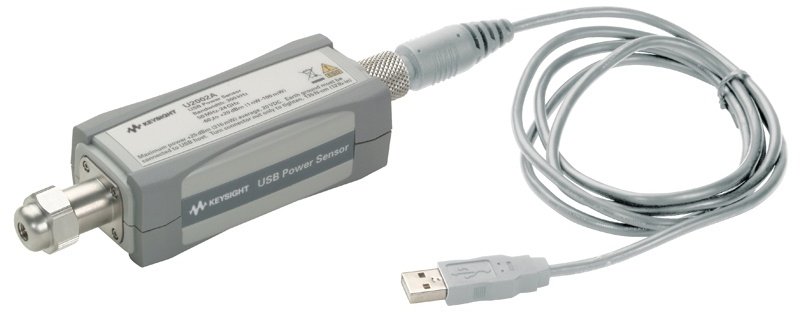
Keysight U2002A
- USB power sensor
- Frequency range: 50 MHz – 24 GHz
- Power range: -60 to +20 dBm
- 5 ft power sensor cable is standard
- For a longer power sensor cable, please see option 302 (10 ft) or 303 (16.4 ft)
USB Power Sensor (50 MHz to 24 GHz; -60 to +20 dBm)
The U2000 Series enable simpler, lower-cost power measurements versus conventional power meter and sensor combinations. With nine high-performance models, the U2000 Series USB power sensors offer compact, high-performance solutions for today’s CW and modulated signals.
| Models | Description | Power Range | Connector Type |
| U2000A | 10 MHz to 18 GHz USB sensor | -60 to +20 dBm | N-type male, 50 Ω |
| U2000B | 10 MHz to 18 GHz USB sensor | -30 to +44 dBm | N-type male, 50 Ω |
| U2000H | 10 MHz to 18 GHz USB sensor | -50 to +30 dBm | N-type male, 50 Ω |
| U2001A | 10 MHz to 6 GHz USB sensor | -60 to +20 dBm | N-type male, 50 Ω |
| U2001B | 10 MHz to 6 GHz USB sensor | -30 to +44 dBm | N-type male, 50 Ω |
| U2001H | 10 MHz to 6 GHz USB sensor | -50 to +30 dBm | N-type male, 50 Ω |
| U2002A | 50 MHz to 24 GHz USB sensor | -60 to +20 dBm | 3.5 mm male, 50 Ω |
| U2002H | 50 MHz to 24 GHz USB sensor | -50 to +30 dBm | 3.5 mm male, 50 Ω |
| U2004A | 9 kHz to 6 GHz USB sensor | -60 to +20 dBm | N-type male, 50 Ω |
Compact “power meters”, simple set-up
The U2000 Series are standalone sensors. That means they essentially operate like power meters, just in smaller forms. No reference calibrator is required. The fact that each sensor draws minimal power from a USB port and that it doesn’t need additional triggering modules or power adaptors to operate makes it more portable, especially for base station testing. Setting up is easy: just plug it into the USB port of your PC or laptop or even select a network or handheld spectrum analyzer and start your power measurements. The figure below illustrates the very simple, straightforward setup of the U2000 Series.

Transform your signal generators and spectrum analyzers into accurate power meters
You could literally have a power meter next to you or instead, turn your Keysight signal generators, handheld spectrum analyzers, or FieldFox handheld RF/Microware analyzers into a power meter for accurate power measurements. Even with the U2000 connected, you can switch between power measurements and the device’s original function at any time. You can also use the U2000 with your Keysight network analyzers for source power calibration.
Intuitive power analysis software
The U2000 Series is supported by the Keysight BenchVue software and BV0007B Power Meter/Sensor Control and Analysis app. Once you plug the USB power sensor into a PC and run the software you can see measurement results in a wide array of display formats and log data without any programming.

U2000 sensor technology
Diode-based sensors frequently rely on the application of correction factors to extend their dynamic range beyond their square-law region, typically in the range of -70 to -20 dBm. While this technique achieves measurement of CW signals over a wide dynamic range, it fails to do so for modulated signals when the signal level is above the square-law region. Modulated signals must be padded down, with their average and peak power levels within the diode square-law region, for accurate average power measurement.
The U2000 Series USB power sensors are true-average, wide-dynamic-range RF/ microwave power sensors, based on a dual-sensor diode pair/attenuator/diode pair topology as proposed by Szente et. al. in 1990 (US Patent #4943764 assigned to Hewlett-Packard Company). The simplified block diagram shown here illustrates this technique.

This technique ensures diodes in the selected signal path are kept in their square law region – with output current and voltage proportional to input power. The diode pair/attenuator/diode pair assembly can then yield the average of complex modulation formats across a wide dynamic range, irrespective of signal bandwidth.
The dual-range Modified Barrier Integrated Diode (MBID) package incorporates diode stacks in place of single diodes. This further improves the measurement accuracy of high-level signals with high crest factors without incurring damage to the sensor.
Implementation of both techniques in the U2000 Series USB sensors enables effective average power measurements of a wide range of signals, including multitone and spread spectrum signals used in CDMA, W-CDMA, and digital television systems.
RF and Microwave Power Sensors Template | |
|---|---|
| LAN version | No |
| Minimum Frequency (RF Power Sensors) | 50 MHz |
| Maximum Frequency (RF Power Sensors) | 24 GHz |
| Sensor Technology | Diode |
You must be logged in to post a review.
Manuals/Guides
Related products


Sale
Rigol DSA710 Spectrum Analyzer 100kHz to 1GHz
Original price was: $1,648.90.$873.91Current price is: $873.91. Add to cart
 Keysight U2002A – USB Po...
 $9,233.40
Our team of knowledgeable professionals is here to help you make informed decisions. Whether you need product recommendations, technical support, or guidance on your purchase, we're just a click away.
Contact Us Now:
📧 sales@nestesinstruments.com
📞 +1 (833) 763-7837
Let us assist you in finding the perfect solution!
Contact Us Now:
📧 sales@nestesinstruments.com
📞 +1 (833) 763-7837
Let us assist you in finding the perfect solution!
Reviews
There are no reviews yet.