No products in the cart.




Description

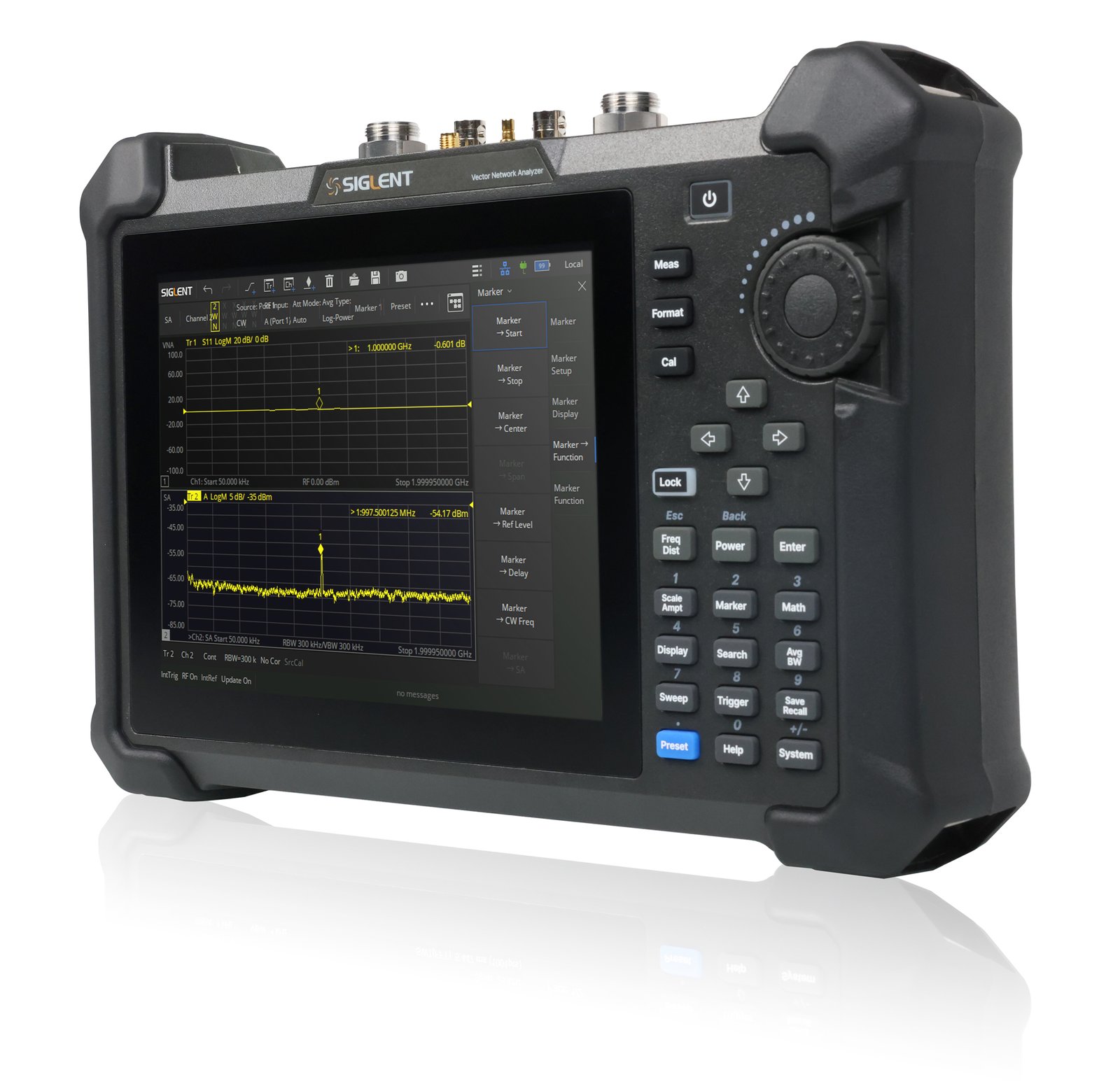
Siglent SHN926A
- Frequency range: 30 kHz – 26.5 GHz
- Specially designed for portable and flexible testing of RF components, cables, antenna base stations and more
- Standard CAT/DTF measurement
- Standard bias-tee for external measured objects
- Standard GPS, time and location information saving (ANT-GPS1 antenna sold separately)
Portable Vector Network Analyzer (30 kHz – 26.5 GHz)
SHN900A series portable vector network analyzer with frequency range up to 26.5GHz, integrates vector network analysis, time domain analysis, spectrum analysis, and standard cable and antenna analysis. It is specially designed for portable and flexible testing of RF components, cables, and systems in R&D, production, maintenance and communications, antenna base stations, and automotive electronics.
The SHN900A provides a portable, easy to use design for complex RF measurements. The SHN900A can operate as a cable and antenna tester including built-in DC voltage bias, a full 2-port vector network analyzer with advanced TDR measurements, pulse measurements, pass-fail limit testing, and complete S-parameters. The SHN900A is a highly integrated, multi-mode RF test system for use in the field and on the line with a 4-hour battery life and a mechanical package suitable to these complex environments.
| Model | Frequency range | Ports | Dynamic range | Range of output |
| SHN914A | 30kHz – 14GHz | 2 | 100dB | -45 dBm ~ +10 dBm |
| SHN920A | 30kHz – 20GHz | 2 | 100dB | -45 dBm ~ +10 dBm |
| SHN926A | 30kHz – 26.5GHz | 2 | 100dB | -45 dBm ~ +10 dBm |
Perform better in the field
SHN900A pursues the ultimate portability and convenience in design, and provides flexible and simple operational methods. SHN900A is designed with high integration, the whole machine weighs less than 7.1 pounds (3.2kg) with a size of 12.2 x 8.5 x 3.1 inches (310 × 215 × 78.5 mm). And it is powered by Li-ion batteries with a life of up to 4 hours, making it suitable for complex environments such as outdoor, narrow space and aerial work.

Vector network analysis (standard)
With a dynamic range of up to 110 dB, the SHN900A is able to meet many high dynamic range testing needs. The low trace noise greatly improves the test accuracy and meets the user’s need for precise measurement. SHN900A supports scattering-parameter/differential-parameter measurement, TDR, VSWR, port matching debugging, insertion loss measurement, tower amplifier debugging, cable fault location, smith chart, pulse measurement, etc.

Cable and antenna analysis (standard)
The CAT mode of the SHN900A verifies and troubleshoots the electrical performance of RF and microwave transmission systems, and is ideal for tasks such as installation and maintenance of antenna systems, distance-to-fault (DTF) measurements on cables, single-port cable loss measurements, and antenna matching measurements.

GPS Location and Logging (Standard)
SNA series portable vector network analyzer combined with GPS function can quickly locate the location of interference sources. Combined with the recording and playback function, it can help users to record the measurement results of spectrum, channel power and adjacent channel power ratio at multiple specific locations, identify and locate interference signals, and better meet the needs of various applications.

Spectrum analysis (requires option SHN900-SA)
Spectrum analysis mode supports the measurement of parameters such as channel power, adjacent channel power ratio (ACPR) and occupied bandwidth. Marker → SA supports a quick view of the spectrum at specific frequency points of the S-parameters, making signal search and analysis more convenient. Simple and clear setup boxes make the testing process simpler, and a series of standardized, repetitive measurements can be performed quickly and easily without error, helping to eliminate human error and supporting the user in making the right measurements from the start.

Time domain analysis (requires option SHN900-TDA)
TDA supports time-domain transformation, windowing, coupling, tagging and gating, which helps to characterize the device from both time-domain and frequency-domain perspectives, such as filtering the desired time-domain response through the gating function, and reducing overshoot and ringing through the windowing function.

Enhanced Time-Domain Analysis (requires option SHN900-TDR)
TDR provides time-domain reflection, transmission analysis and eye diagram simulation analysis functions, compared with ordinary frequency-domain analysis, it can quickly locate the fault point, determine the type of fault, can use the built-in virtual code generator to generate simulated eye diagrams, with jitter injection function to simulate the impact of the input signal with jitter on signal transmission.

Rear panel layout

1. Port 1 – The RF signal input and output port is a 50 Ω SMA 3.5mm male connector, which can also be configured as a DC output to provide bias voltage. Maximum input ±50 VDC, + 30 dBm.
2. Trig in – Trigger input is a BNC female connector. When the analyzer uses an external trigger mode, the connector receives a rising or falling edge of an external trigger signal that is used to establish event synchronization.
3. Ref in – Reference clock input, BNC female connector. The analyzer can use an internal reference clock or an external reference clock. If the instrument detects a signal from an external 10 MHz reference clock, it automatically uses the signal as the analyzer’s reference clock source. Used to establish clock synchronization between multiple instruments.
4. Port 2 – The RF signal input and output port is a 50 Ω SMA 3.5mm male connector, which can also be configured as a DC output to provide bias voltage. Maximum input ±50 VDC, + 30 dBm.
5. K-Groove – Slots for Kensington cable lock
6. GPS Ant – The GPS antenna port is a SMA female connector used to install the GPS antenna and receive GPS satellite signals. Can provide 3.3V DC feed for active GPS antenna.
7. Bias out – The offset voltage output port is a 50Ω female SMB connector. Used to provide bias voltage for external signal amplifiers, such as tower amplifiers.
8. USB Device – The main USB port is TypeC. The analyzer can be used as a slave device and connected to a PC via USB cable. The PC uses the USBTMC protocol to remotely control the analyzer.
9. USB Host – USB slave port, Type B. The analyzer can be used as the main device and is connected to external USB devices through this port.
10. LAN – RJ45 ports. The analyzer is connected to the LAN through network cable, and can be viewed and controlled remotely through VXI, Socket protocol, or a web browser.
11. External power supply – 2.5mm x 5.5mm barrel connector. Used to power devices and charge batteries.
Spectrum Analyzers/Spectrum Analyzers Template | |
|---|---|
| Bandwidth Range Max | 26.5 GHz |
| Bandwidth Range Min | 30 kHz |
| Noise Floor | -110 dB |
| Type(Spectrum Analyzers) | Handheld |
Product General Attributes | |
| Warranty | 3 YEARS |
| Interfaces I/O | LAN / Ethernet, USB Host, USB |
| Battery Type | Li-ion |
| Power Supply Voltage | Battery Powered |
You must be logged in to post a review.
Manuals/Guides
ManualsSpec Sheets
Related products


Sale

Rohde and Schwarz FPL-EMI7 – FPL1007 EMI Debugging Package with Options B5/B9/B22/K54
Original price was: $32,213.50.$32,052.43Current price is: $32,052.43. Add to cart Siglent SHN926A – Portab...
 $27,808.00
Our team of knowledgeable professionals is here to help you make informed decisions. Whether you need product recommendations, technical support, or guidance on your purchase, we're just a click away.
Contact Us Now:
📧 sales@nestesinstruments.com
📞 +1 (833) 763-7837
Let us assist you in finding the perfect solution!
Contact Us Now:
📧 sales@nestesinstruments.com
📞 +1 (833) 763-7837
Let us assist you in finding the perfect solution!
Reviews
There are no reviews yet.