No products in the cart.

Description
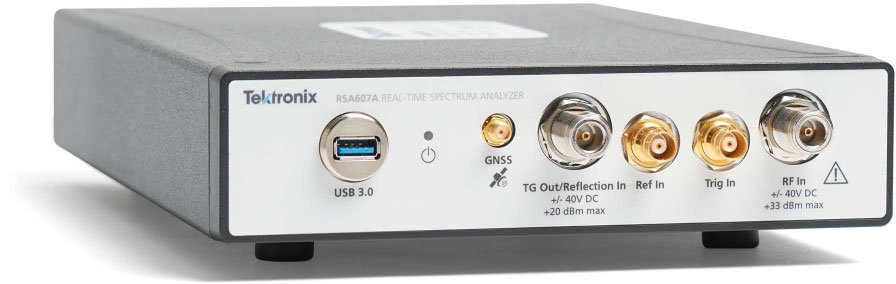
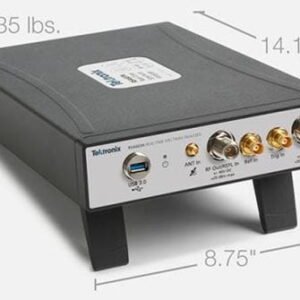
Tektronix RSA607A – Real Time Spectrum Analyzers (9 kHz to 7.5 GHz Frequency Range)

- Frequency Range: 9 kHz-7.5 GHz
- Real-Time Bandwidth: 40 MHz
- Minimum Event Duration for 100% POI: 100 μs
- SFDR (typical): 70 dBc
- Amplitude accuracy of 0.2 dB to 3 GHz (95% confidence)
The RSA607A brings real-time spectrum analysis and wide analysis bandwidth to solving the problems of engineers who need to characterize, validate and manufacture their designs. The heart of the system is the USB-based RF spectrum analyzer that captures 40 MHz bandwidths with great fidelity. With a 70 dB dynamic range and frequency coverage to 7.5 GHz, you can fully characterize wideband signals up to 40 MHz bandwidths. The USB form factor moves the processing power to the PC of your choice, so you decide when you need more processing power or memory.
The optional tracking generator enables gain/loss measurements for quick tests of filters, amplifiers, duplexers, and other components, and you can add cable and antenna measurements of VSWR, return loss, distance to fault, and cable loss as needed.
SignalVu-PC software offers rich analysis capability for your lab
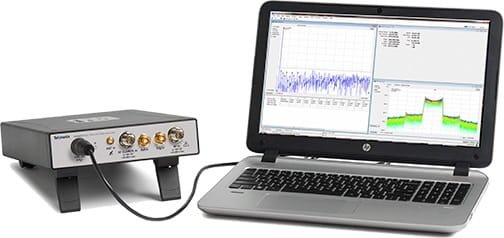
The RSA607A operates with SignalVu-PC, a powerful program used as the basis of Tek’s traditional spectrum analyzers. SignalVu-PC offers a deep analysis capability previously unavailable in low-cost laboratory solutions. Real-time processing of the DPX spectrum/spectrogram is enabled in your PC, further reducing the cost of hardware. Customers who need programmatic access to the instrument can choose either the SignalVu-PC programmatic interface or use the included application programming interface (API) that provides a rich set of commands and measurements directly. The basic functionality of the free SignalVu-PC program is far from basic. Base version measurements are shown below.
See the invisible with real-time DPX® technology.
Discover the most difficult, hard-to-find problems with the powerful real-time architecture of the RSA Series. With the advanced DPX® technology, you can see RF characteristics that are practically invisible to a conventional spectrum analyzer.


Get up to 26 add-on packages. Bluetooth 5 and pulsed signal analysis are just the starts.
The RSA600 is powered by SignalVu-PC Vector Signal Analysis software – the same software used on the full-line of Tektronix Real-time Spectrum Analyzers. Delivering unlimited access to advanced measurement and analysis capabilities that you can save, customize or share with peers. Over 15 packages cover common wireless standards, spectrum management, pulse measurements, and more.
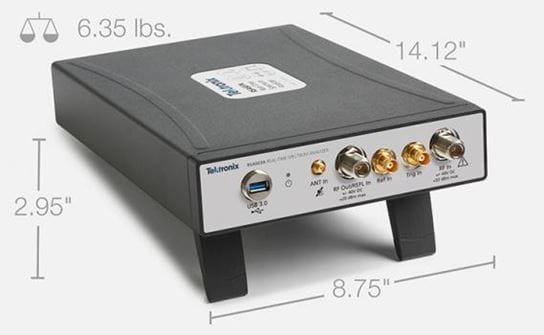
Unequaled size. Unlimited flexibility.
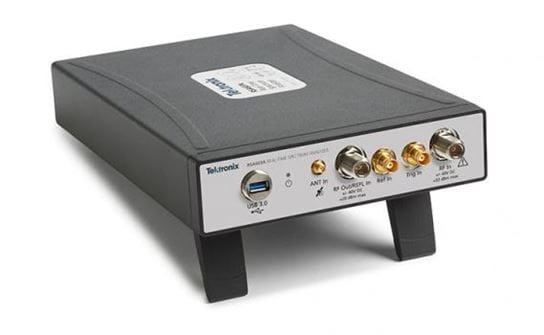
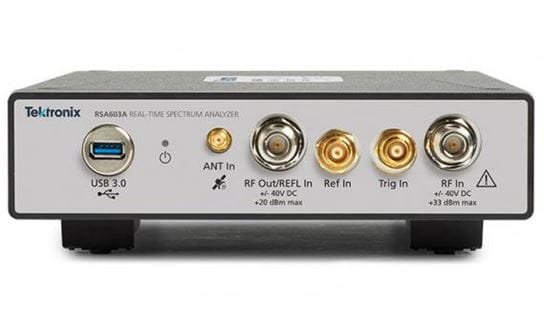
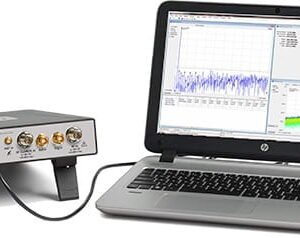
The RSA600 is conveniently sized to fit on your bench, in your lab, or stacked side-by-side on a rack. Continuously stream up to 40 MHz of data to your own Intel i5 or i7 PC, laptop, or tablet via USB 3.0. and unlock the latest in PC processing power, convenient file sharing, SignalVu-PC Vector Signal Analysis (VSA) software, and Windows or Linux APIs for building custom IQ-based applications. You choose the display and PC. Upgrade when you need or choose to.


Signal quality validation of WLAN, Bluetooth, LTE, and more for wireless transmitter design.
With modulation analysis for WLAN, Bluetooth, LTE, and more, the RSA600 enables straightforward design characterization, troubleshooting, and certification at a low price. The internal tracking generator allows you to characterize RF components and systems.
The RSA600A combined with SignalVu-PC options offers advanced measurements
With 40 MHz of real-time bandwidth, the unique DPX® spectrum/spectrogram shows you every instance of an interfering or unknown signal, even down to 15 μs in duration. The following image shows a WLAN transmission (green and orange), and the narrow signals that repeat across the screen are a Bluetooth access probe. The spectrogram (upper part of the screen) clearly separates these signals in time to show any signal collisions.

Finding unexpected signals is easy with unattended mask monitoring. A mask can be created on the DPX® spectrum display, and actions taken upon every violation, including stop, save a picture, save acquisition, or send an audible alert. In the illustration below, a mask violation has occurred in red on the mask, and a picture of the screen was saved as a result. Mask testing can be used for unattended monitoring and when playing back recorded signals, enabling testing for different violations on the same signals.

The tracking generator (Option 04 on the RSA600) is controlled via SignalVu-PC. A bandpass filter response from 800 MHz to 3 GHz is shown below. Option SV60 adds return loss, cable loss, and distance to the fault.

EMC/EMI
EMI pre-compliance and diagnostic measurements are easy with the instrument and SignalVu-PC. Transducer, antenna, preamplifier, and cable gain/loss can be entered and stored in correction files, and the standard spurious measurement feature of SignalVu-PC can be used to establish limit lines for your test. The following illustration shows a test from 30MHz to 960 MHz against the FCC Part 15 Class A limit shown shaded. The blue trace is the capture of Ambient. Violations are recorded in the results table below the graph. CISPR quasi-peak and average detectors can be added with option SVQP.
The EMC pre-compliance solution can be added with option EMCVU. It supports many predefined limit lines. It also adds a wizard for easy setup of recommended antennas, LISN, and other EMC accessories with a one-button push. When using the new EMC-EMI display, you can accelerate the test by applying the time-consuming quasi-peak only on failures. This display also provides a push-button ambient measurement. The Inspect tool lets you measure frequencies of interest locally, removing the need for scanning.

SignalVu-PC application-specific licenses
SignalVu-PC offers a wealth of application-oriented options available either installed on the instrument, or as a floating license that can be moved between instruments or attached to your PC. Applications include:
- General-purpose modulation analysis (27 modulation types including 16/32/64/256 QAM, QPSK, O-QPSK, GMSK, FSK, APSK)
- EMC/EMI analysis with CISPR peak, quasi-peak, and average detectors
- Bluetooth® analysis of Basic Rate, Low Energy, and Bluetooth 5. Some support of Enhanced Data Rate
- P25 analysis of phase I and phase 2 signals
- WLAN analysis of 802.11a/b/g/j/p, 802.11n, 802.11ac
- LTE™ FDD and TDD Base Station (eNB) Cell ID and RF measurements
- Mapping
- Pulse analysis
- AM/FM/PM/Direct Audio Measurement including SINAD, THD
- Playback of recorded files, including complete analysis in all domains
- Signal classification and survey
General-purpose modulation analysis
SignalVu-PC application SV21 bundles 27 different modulation types into a single analysis package and offers constellation displays, eye diagrams, symbol tables, trellis diagrams, modulation quality summaries, and more. Symbol rates and filter types are adjustable and an internal equalizer is included for signal optimization. The illustration below is of a TETRA-standard signal modulated with pi/4DQPSK modulation at 18.0 symbols/sec.

Bluetooth
Two new options have been added to help with Bluetooth SIG standard base transmitter RF measurements in the time, frequency, and modulation domains. Option SV27 supports Basic Rate and Low Energy Transmitter measurements defined by RF.TS.4.2.0 and RF-PHY.TS.4.2.0 Test Specification. It also demodulates and provides symbol information for Enhanced Data Rate packets. Option SV31 supports Bluetooth 5 standards (LE 1M, LE 2M, LE Coded) and measurements defined in the Core Specification. Both options also decode the physical layer data that is transmitted and color-encode the fields of the packet in the Symbol Table for clear identification.

Pass/Fail results are provided with customizable limits. Measurement below shows deviation vs. time, frequency offset, and drift and a measurement summary with Pass/Fail results.

APCO 25
SignalVu-PC application SV26 enables the analysis of APCO P25 signals. The following image shows a Phase II HCPM signal being monitored for anomalies with the spectrogram while performing transmitter power, modulation, and frequency measurements to the TIA-102 standards specification.

LTE
Application SV28 enables the following LTE base station transmitter measurements:
- Cell ID
- Channel power
- Occupied bandwidth
- Adjacent channel leakage ratio (ACLR)
- Spectrum emission mask (SEM)
- Transmitter off power for TDD
- Reference Signal (RS) Power
The measurements follow the definition in 3GPP TS Version 12.5 and support all base station categories, including picocells and femtocells. Pass/Fail information is reported and all channel bandwidths are supported.
The Cell ID preset displays the Primary Synchronization Signal (PSS) and the Secondary Synchronization Signal (SSS) in a Constellation diagram. It also provides Frequency Error.
The illustration below shows spectral monitoring with the spectrogram display combined with a Cell ID/Constellation, Spectrum Emission Mask and ACLR measurements.

WLAN 802.11a/b/g/j/p/n/ac
With options SV23, 24, and 25, sophisticated WLAN measurements are easy. On the 802.11ac (20 MHz) signal shown, the spectrogram shows the initial pilot sequence followed by the main signal burst. The modulation is automatically detected as 64 QAM for the packet and displayed as a constellation. The data summary indicates an EVM of -37.02 dB RMS, and burst power is measured at -17.32 dBm. SignalVu-PC applications are available for 802.11a/b/j/g/p, 802.11n, and 802.11ac to 40 MHz bandwidth.

Playback
Application SV56, Playback of recorded signals, can reduce hours of watching and waiting for a spectral violation to minutes at your desk reviewing recorded data.
Recording length is limited only by storage media size, and recording is a basic feature included in SignalVu-PC. SignalVu-PC application SV56 (Playback) allows for complete analysis by all SignalVu-PC measurements, including DPX Spectrogram. Minimum signal duration specifications are maintained during playback. AM/FM audio demodulation can be performed. Variable span, resolution bandwidth, analysis length, and bandwidth are all available.
In the illustration below, the FM band is being replayed, with a mask applied to detect spectral violations, simultaneous with listening to the FM signal at the center frequency of 92.3 MHz.

DataVu-PC for multi-instrument recording and analysis of large recordings
DataVu-PC software can control two spectrum analyzers simultaneously with independent settings. This allows you to monitor a wide span while recording at up to 40 MHz bandwidth at any frequency in the range of the instrument. Once recorded, DataVu-PC can find and mark signals of interest based on amplitude and frequency-mask characteristics, eliminating the need for manual inspection of long recordings. Pulse measurements are available on up to 2,000,000 pulses.
Spectrum Analyzers/Spectrum Analyzers Template | |
|---|---|
| Tracking Generator | Yes |
| Channel Power Measurement | Yes |
| Auto tuning | No |
| AM/FM Demodulation | Yes |
Product General Attributes | |
| Country of Origin | United States |
You must be logged in to post a review.
Related products

Sale

Rohde and Schwarz FPL1003 – Signal and Spectrum Analyzer, 5 kHz to 3 GHz
Original price was: $15,994.00.$12.10Current price is: $12.10. Add to cart
Sale
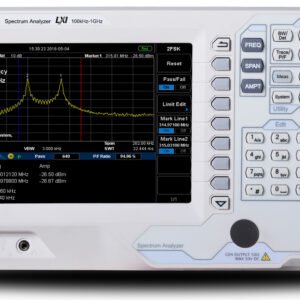
Rigol DSA710 Spectrum Analyzer 100kHz to 1GHz
Original price was: $1,648.90.$873.91Current price is: $873.91. Add to cart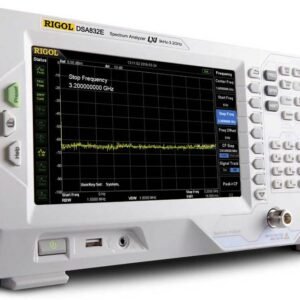
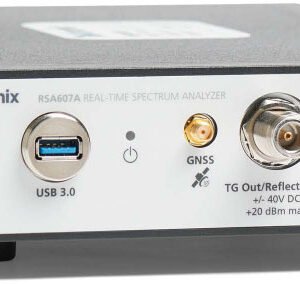 Tektronix RSA607A – Real...
 $20,460.00
Our team of knowledgeable professionals is here to help you make informed decisions. Whether you need product recommendations, technical support, or guidance on your purchase, we're just a click away.
Contact Us Now:
📧 sales@nestesinstruments.com
📞 +1 (833) 763-7837
Let us assist you in finding the perfect solution!
Contact Us Now:
📧 sales@nestesinstruments.com
📞 +1 (833) 763-7837
Let us assist you in finding the perfect solution!
Reviews
There are no reviews yet.