No products in the cart.

Sale


Description

Armada GFL3000
- Locates Buried Ground Faults
- Dual Power Capabilities (Hi/Lo)
- Audible ‘On’ Beeper
- Battery Power Indicator
- Custom Molded Case
Ground Fault Locator
The Armada Technologies GFL3000 Ground Fault Locator is designed to find wire or cable damage that results in an electrical path to ground. The GFL3000 works on the principle of earth gradient theory and is sometimes referred to as an earth gradient fault detector. The GFL3000 will pinpoint the exact location of a grounded cable fault. The GFL3000 is NOT a cable path locator. You will likely need a separate cable locator to locate the path of the entire cable.

The complete kit for the GFL3000 kit consists of the following;
| (1) GFL3000R Receiving Box | (1) ProGS Ground Stake |
| (1) GFL3000AF Receiving Frame | (1) Battery Charger |
| (1) GFL3000T Dual Power Transmitter (with rechargeable battery) | (1) Operating Manual |
How it Works
The GFL3000T transmits a voltage charge in succession approximately every 2 seconds. The charge is applied through the leads and into the connected cable where they travel to the ground fault. At the ground fault, some of the electrical current leaks to the earth’s ground.
The receiver/A-frame is then inserted into the ground along the path of the wire. As the current flows down the wire, it travels out through the ground fault and then back to the ground stake. Some of this current, however, travels through the A-frame receiver. The needle at the top of the A-Frame will give a directional kick either left or right. The initial kick direction is the one that determines the direction. Usually after this initial kick, the needle will rebound in the opposite direction. Only the initial kick is important.
The receiver determines which side of the frame received the current first and therefore, which direction the fault lies. By relocating the frame, the user can zero in as to exactly where the fault lies.
Batteries – The GFL3000 transmitter uses a 12v rechargeable battery (included). There are also 110v AC and cigarette lighter rechargers included for this battery. The battery comes disconnected in shipping. To connect the battery, remove the finger screws located on each side of the transmitter control panel. Inside the compartment, you will see the battery and 2 connecting terminals using spade clips. Carefully remove the rubberized terminal covers and connect the spade-clipped wires to the battery. Replace the cover and tighten the screws.
To recharge the transmitter battery, connect the charger to the charging receptacle on the transmitter and then plug into a wall outlet. The battery level indicator on the transmitter face will indicate the amount of charge in the battery.
The receiver module that sits atop the frame requires (1) 9V battery. Remove the screws on each side of the receiver and remove the cover. Tightly connect the 9v square battery to the battery boot and replace the cover.
Operational Warnings – The GFL3000 transmits a high-voltage charge. Do not turn the transmitter on until all hook-ups are complete. This means the alligator clip to the ground stake and the alligator clip to the wire. NEVER TURN ON THE UNIT WHEN ANYONE IS TOUCHING THE CABLE, GROUND STAKE, OR ANY PART OF THE TRANSMITTER. Disconnect the wire to be tested from any other service, components, or anything that might be affected by high voltage. Completely isolate the cable.
FAILURE to follow instructions could lead to injury or death.
Operation
1. Disconnect cable to be tested at both ends. Be sure you are disconnected from power, components or anything else that will transmit electrical current. This isolates the cable and forces the current generated by the GFL3000 to exit the cable at the fault.
2. Assemble the A-Frame receiver by placing the small electronic receiver module on top of the receiver frame and secure it with the 2 thumb screws attached to the A-Frame.
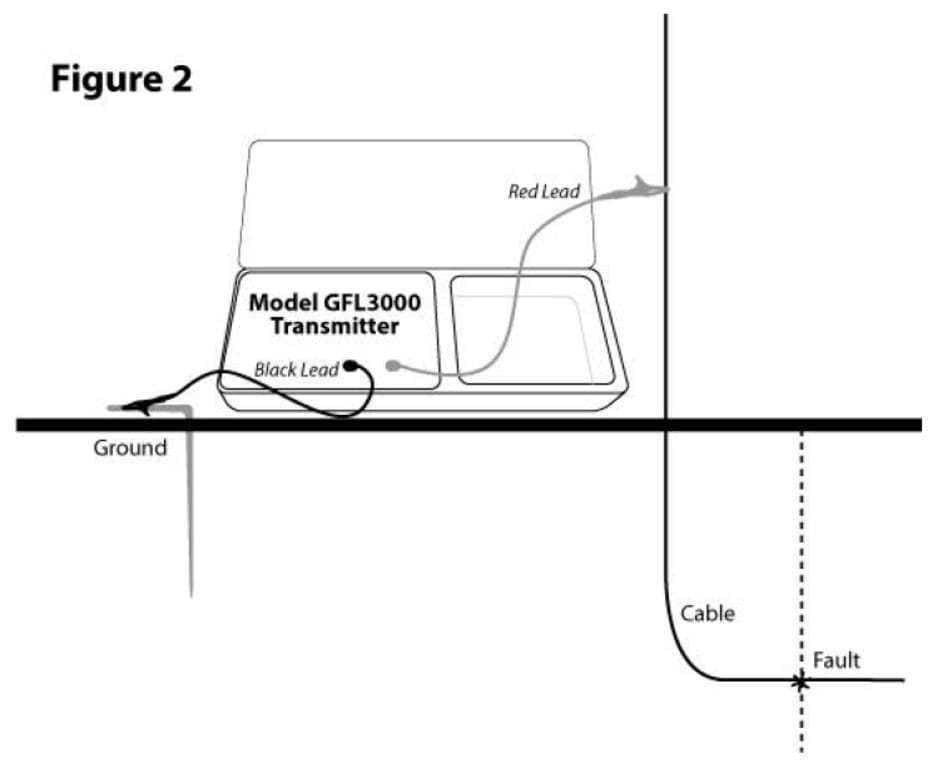
3. Starting at either end of the cable and with the transmitter off, connect the black alligator clip lead to the ground stake and shove the stake into the ground as deeply as possible. Connect the red alligator clip lead to the cable to be tested.
4. After being sure that no one is touching the stake, cable, or leads, turn the GFL3000 transmitter on by placing the rocker switch in the “on” position. The transmitter will produce an audible beeping sound indicating the current is being transmitted. Do not handle any component, cable, or stake while the GFL3000 is operating.
5. Select low (2400v) or high (3200v) power as per your preference. High power will find large or small leakages while low power will concentrate on larger faults. If you want to find all faults regardless of size, use high. If you are looking for larger faults only, use the low setting.
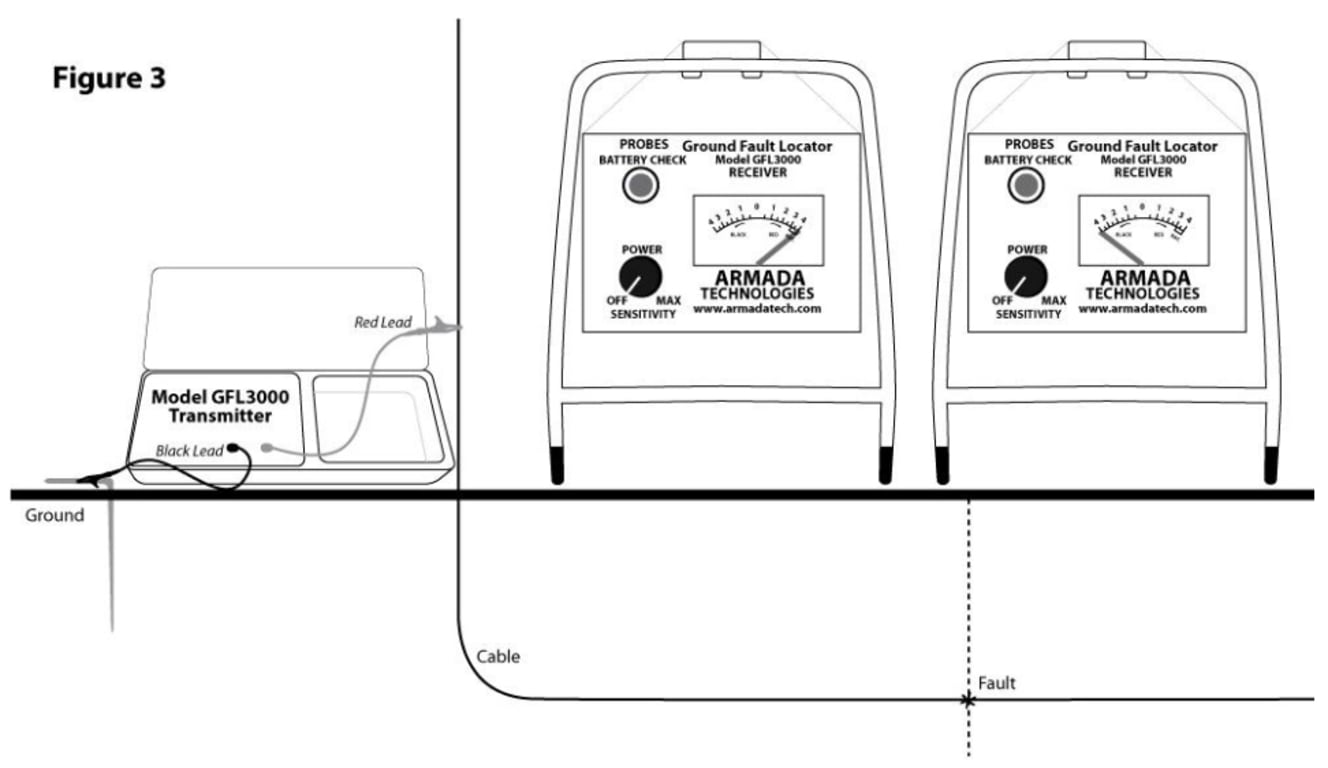
6. Turn the receiver on and place the A-Frame probes in the ground parallel to the path of the cable. Be sure to insert them into the ground. As the transmitter pulses, you should see the analog needle of the GFL3000 kick in the direction of the fault. Remember, it is the initial kick you are watching for, not the rebound kick.
7. Remove the A-Frame probes from the ground and move it in the direction of the initial needle kick along the path of the cable. Re-insert the A-Frame probes into the ground and repeat the process of observing the direction of the initial needle kick.
8. As you pass the fault, the needle kick direction will reverse. In other words, as you continue down the path of the cable and follow the needle kicks, the needle will reverse its initial direction of kick after you pass the fault. This indicates a fault is between the last 2 A-Frame insertion points.
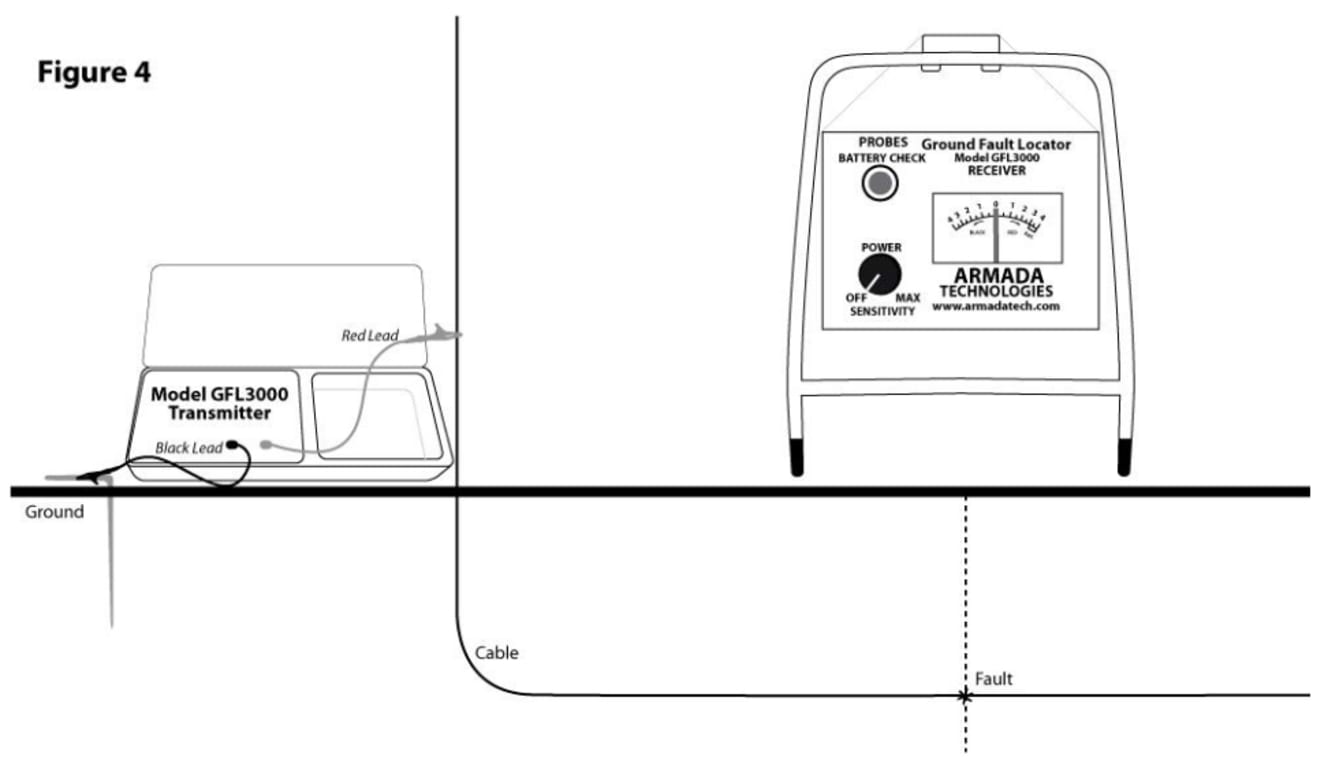
9. Continue to move the frame along the path in the direction of the initial kick, zeroing in on the location of the fault. When you are directly over the fault, the needle will cease to kick. Mark the spot for repair.
10. BEFORE REPAIR, TURN OFF THE GFL3000 TRANSMITTER AND DISCONNECT IT FROM THE CABLE. NEVER TOUCH THE TRANSMITTER, TRANSMITTER LEADS, OR CABLE BEING TESTED WHILE THE TRANSMITTER IS ON. DO NOT USE THE GFL3000 IN THE RAIN.
FAILURE TO READ AND UNDERSTAND THESE WARNINGS COULD LEAD TO INJURY OR DEATH.

You must be logged in to post a review.
Manuals/Guides
Related products
Sale
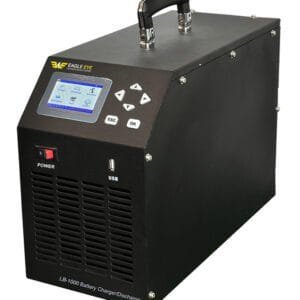
Eagle Eye LB-1000 – Battery Charger / Discharger / Activator
Original price was: $6,840.00.$6,035.29Current price is: $6,035.29. Add to cartSale

Eagle Eye LB-240-500-CCD – 240V, 500A Constant Current Load Bank with Data and Software
Original price was: $45,442.11.$40,095.98Current price is: $40,095.98. Add to cartSale
Eagle Eye LB-380-100-CCD – DC Load Bank with Data and Software
Original price was: $19,105.27.$16,857.59Current price is: $16,857.59. Add to cartSale
Eagle Eye LB-380-200-CCD – DC Load Bank with Data and Software
Original price was: $32,052.64.$28,281.73Current price is: $28,281.73. Add to cartSale

Eagle Eye LB-400-120- 400Hz, 120kW at 200VAC 3-Phase
Original price was: $16,514.29.$15,380.95Current price is: $15,380.95. Add to cart Armada GFL3000 – Ground ...
 Original price was: $1,199.00.$966.94Current price is: $966.94.
Our team of knowledgeable professionals is here to help you make informed decisions. Whether you need product recommendations, technical support, or guidance on your purchase, we're just a click away.
Contact Us Now:
📧 sales@nestesinstruments.com
📞 +1 (833) 763-7837
Let us assist you in finding the perfect solution!
Contact Us Now:
📧 sales@nestesinstruments.com
📞 +1 (833) 763-7837
Let us assist you in finding the perfect solution!
Reviews
There are no reviews yet.