No products in the cart.

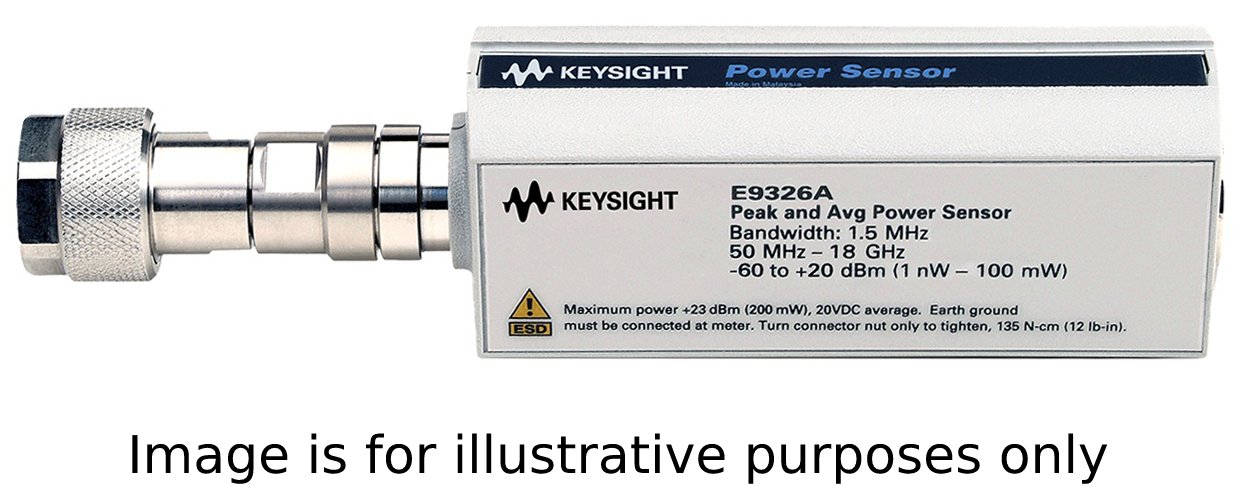
Description

Keysight E9321A
- Peak and average power sensor
- Frequency range: 50 MHz to 6 GHz
- Video bandwidth: 300 kHz
- Ideal for time-gated peak, average and peak-to-average ratio power measurements on TDMA wireless formats such as NADC, GSM, and EDGE
Peak/Average Power Sensor (50 MHz – 6 GHz; 300 kHz Video Bandwidth)
The E-Series E9320 power sensors have two frequency ranges. The E9325A, E9326A, and E9327A have a frequency range of 50 MHz to 18 GHz while the 50 MHz to 6 GHz range of the E9321A, E9322A, and E9323A covers most wireless communication applications.
| Sensor Model | Video Bandwidth | Frequency Range | Maximum Power | Connector Type |
| E9321A | 300 kHz | 50 MHz to 6 GHz | +23 dBm average; +30 dBm peak (< 10 µsec duration) | Type N (m) |
| E9325A | 300 kHz | 50 MHz to 18 GHz | +23 dBm average; +30 dBm peak (< 10 µsec duration) | Type N (m) |
| E9322A | 1.5 MHz | 50 MHz to 6 GHz | +23 dBm average; +30 dBm peak (< 10 µsec duration) | Type N (m) |
| E9326A | 1.5 MHz | 50 MHz to 18 GHz | +23 dBm average; +30 dBm peak (< 10 µsec duration) | Type N (m) |
| E9323A | 5 MHz | 50 MHz to 6 GHz | +23 dBm average; +30 dBm peak (< 10 µsec duration) | Type N (m) |
| E9327A | 5 MHz | 50 MHz to 18 GHz | +23 dBm average; +30 dBm peak (< 10 µsec duration) | Type N (m) |
- E9321A and E9325A sensors with 300 kHz bandwidth are suitable for measuring TDMA signals such as GSM
- E9322A and E9326A sensors with 1.5 MHz bandwidth are suitable for measuring IS-95 CDMA signals
- E9323A and E9327A sensors with 5 MHz bandwidth are suitable for measuring W-CDMA signals
Measurement ranges
The E9320 power sensors have two measurement ranges (lower and upper).
| E9321A/E9325A | E9322A/E9326A | E9323A/E9327A | ||||
| Normal | Average only | Normal | Average only | Normal | Average only | |
| Lower range (min. power) | -50 dBm | -65 dBm | -45 dBm | -60 dBm | -40 dBm | -60 dBm |
| Lower range (max. power) | +0.5 dBm | -17.5 dBm¹ | -5 dBm | -13.5 dBm² | -5 dBm | -10.5 dBm² |
| Lower to upper auto range point | +0.5 dBm | -17.5 dBm¹ | -5 dBm | -13.5 dBm² | -5 dBm | -10.5 dBm² |
Upper to lower auto range point | -9.5 dBm | -18.5 dBm | -15 dBm | -14.5 dBm | -15 dBm | -11.5 dBm |
| Upper range (min. power) | -35 dBm | -50 dBm | -35 dBm | -45 dBm | -30 dBm | -35 dBm |
| Upper range (max. power) | +20 dBm | +20 dBm¹ | +20 dBm | +20 dBm² | +20 dBm | +20 dBm² |
¹ For average power measurements, free run acquisition
² Applies to CW and constant amplitude signals only above -20 dBm
Use the default normal path for continuously sampled measurements of modulated signals and time-gated measurements. For each frequency range, there is a choice of sensors with three videos (modulation) bandwidths.
Note: however, that the sensors with the widest bandwidth have the smallest dynamic range (in normal mode). If the dynamic range is an important factor, use the sensor model with just enough video bandwidth for the measurement you want to make.
The average-only path is suitable for average power measurements of Continuous Wave (CW) and constant amplitude signals between -65 dBm (sensor dependent) and +20 dBm. The average-only path can also be used to measure the true average power of any complex modulated signal below -20 dBm.
Calibration factors, linearity, temperature, and bandwidth compensation data are stored in the sensor EEPROM during the manufacturing process. All the compensation data is downloaded to the EPM-P Series power meter at power-on or when the sensor is connected. You only need to enter the frequency of the RF signal you are measuring to achieve a high degree of accuracy.
RF and Microwave Power Sensors Template | |
|---|---|
| LAN version | No |
| Minimum Frequency (RF Power Sensors) | 50 MHz |
| Maximum Frequency (RF Power Sensors) | 6 GHz |
| Sensor Technology | Diode |
You must be logged in to post a review.
Manuals/Guides
BrochuresManualsSpec SheetsApplication Notes
Related products


Sale

Rigol DSA815-TG 9kHz to 1.5GHz with Pre-Amplifier and Tracking Generator Spectrum Analyzer
Original price was: $1,428.90.$1,100.25Current price is: $1,100.25. Add to cart

 Keysight E9321A – Peak/A...
 $3,361.60
Our team of knowledgeable professionals is here to help you make informed decisions. Whether you need product recommendations, technical support, or guidance on your purchase, we're just a click away.
Contact Us Now:
📧 sales@nestesinstruments.com
📞 +1 (833) 763-7837
Let us assist you in finding the perfect solution!
Contact Us Now:
📧 sales@nestesinstruments.com
📞 +1 (833) 763-7837
Let us assist you in finding the perfect solution!
Reviews
There are no reviews yet.