No products in the cart.

Sale
Description
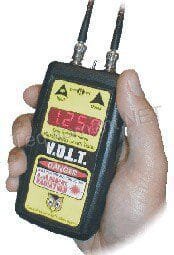
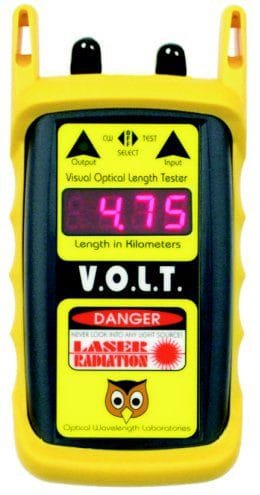
OWL VOLT-1 – Visual Optical Length Tester

- Pulsed mode provides easy fiber identification
- Measures the length of both single mode and multi-mode fiber with accuracy of ± 2.5 meters
- High-intensity visible laser allows for visible fault location of breaks and microbends
- Easy-to-read bright red 7-segment LED display, 15 hours continuous use on one 9v battery, and Low battery indicator
VOLT stands for Visual Optical Length Tester, and offers a unique, low-cost alternative for users who need to measure the length of optical fibers.
Fiber installations are increasingly required to have fiber length measurements to comply with bid requirements. Rather than purchase certification test sets that can cost thousands of dollars, the VOLT can be added to an installer’s existing fiber test kit.
These length testers use a “round-robin” method of measuring fiber length. This is accomplished by looping back two fibers at one end of the fiber run with a patch cord. The round trip time that the light takes to travel through both fibers is converted to length in kilometers, then divided by two to show the length of the fiber cable. There is no need to measure the length of all the fibers; the length measurement can be applied to all fibers in the cable. This method of length testing provides accurate measurements, and saves time and money.
Measuring fiber by the jacket is an accepted method of measurement; however, there are many scenarios where this may not be valid. Length markings may be hard to reach if they are already terminated in a patch panel. Fiber links may also go through multiple cross-connects or have splices in the middle, thereby making jacket markings invalid. Optical measurement of fiber produces accurate results without the need for jacket markings.
Optical measurement also saves time by eliminating the need to estimate the length of the fiber run with a measuring wheel. This method is especially troublesome and inaccurate in networks that traverse walls, are in a star topology, or contain riser cables. The VOLT uses a visible laser that can measure fiber links of up to 1.5 kilometers, and is accurate to within ±2.5 meters. In addition to length testing, the VOLT’s high-intensity laser permits it to do double duty as a visual fault locator, and a pulsing mode allows for easy fiber identification.
NOTE: To avoid confusion, the VOLT is NOT designed to measure distance to a fault like an OTDR. The VOLT is designed to measure the end-to-end length of a fiber cable. A pair of terminated fibers, looped back at the far end of the cable, are required for end-to-end fiber cable length measurement (see diagram below).

General Features
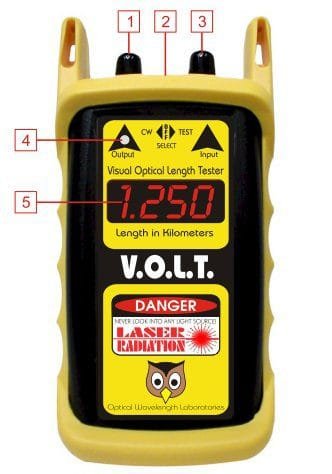
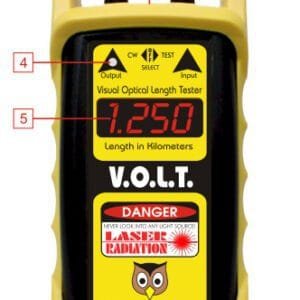
- BRIGHT RED LASER TRANSMITTER – this ST connector port houses a laser diode that emits bright red visible light into an optical fiber.
- CONTINUOUS WAVE/TEST SELECTOR SWITCH – this 3-way switch selects between OFF (center), length testing / fiber identification mode (right), and continuous wave mode (left).
- DETECTOR PORT – this ST connector port houses a photodiode detector used to receive light from an optical fiber.
- POWER LED – this LED indicates that the tester is powered on. During normal operation, if this LED is very dim or is not lit, this indicates that the battery may not have sufficient power for accurate testing, and should be replaced.
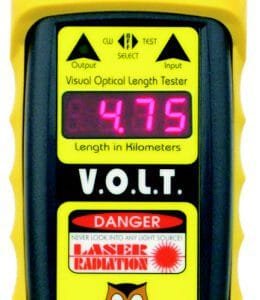
- LED DISPLAY – this 7-segment LED is used to display the length of the fiber link in kilometers. If the display shows all dashes, the VOLT is not receiving enough light to make a measurement. This means that either the link is either too long to be measured or there is a problem with one of the fibers used for length measurement.

Applications
Fiber Length Measurement. The VOLT uses a “round robin” method of length measurement. This method requires two fibers from the same fiber cable to be looped back at one end with a patch cord. Light is injected into one of the fibers by the transmitter and is received by the detector connected to the other fiber. The round trip travel time is converted into length in kilometers and divided by two to arrive at the length of the fiber cable. It is not necessary to test each fiber for length; the length measurement applies to all fibers in the cable.
- On one end of the fiber cable, loop back two of the fibers with one of the patch cords.
- On the other end of the fiber cable, connect one patch cord to each of the fibers being used for the test. Connect the other end of the patch cords to the receiver and transmitter ports on the VOLT. It does not matter which patch cord connects to which fiber.
- Power on the VOLT into length test mode by flipping the switch to TEST. In a few seconds, the display will show the length of the fiber in kilometers. In the example at right, the link is 1.250 kilometers.
NOTE: If the green indicator LED does not light up, the battery has insufficient power for a valid test, and must be replaced before continuing.

Visual Fiber Identification. The VOLT provides a flashing mode for easy visual fiber identification. Fibers are identified by locating the fiber end with the flashing red light on the opposite end of the fiber cable. This is useful for locating fibers that are marked incorrectly or not marked at all.
- Connect the VOLT to the fiber you are testing via a patch cord as shown at right.
- Power ON the VOLT into fiber identification mode by flipping the switch to TEST. This mode emits a flashing beam of high-intensity red light into the fiber.
- Identify the fiber by looking for the flashing red light emitting from the connector.

Visual Fault Location. In Continuous Wave Mode, a steady beam of ultra-bright red laser light is injected into the fiber. If this light encounters a break or microbend in the fiber, the light will be redirected into the buffer. This light will be visible through the fiber jacket, informing the user of a break or microbend in the fiber.
- Connect the VOLT to the fiber you are testing via a patch cord as shown at right.
- Power ON the VOLT to visual fault location mode by flipping the switch to CW. If there is a fault in the first few meters of the fiber, red light should appear as a red glow through the fiber jacket.

Product General Attributes | |
|---|---|
| Product Weight | 1 LBS |
| Country of Origin | United States |
You must be logged in to post a review.
Manuals/Guides
Other
| Weight | 1 lbs |
|---|
Related products
Sale

Fluke Networks MT-8200-49A MicroMapper
Original price was: $180.38.$152.55Current price is: $152.55. Add to cartSale

TREND Networks 150054 – Advanced Wire Map Remote (Formerly IDEAL Networks)
Original price was: $60.50.$57.47Current price is: $57.47. Add to cartSale

Fluke Networks CIQ-WM CABLEIQ Wiremap Adapter
Original price was: $179.28.$151.62Current price is: $151.62. Add to cartSale

Fluke Networks LIQ-KIT – LinkIQ™ Cable+Network Tester Kit
Original price was: $3,681.68.$3,131.65Current price is: $3,131.65. Add to cartSale
Fluke Networks LIQ-KIT-IE – LinkIQ™ Tester with Industrial Ethernet Adapter Kit And Probe
Original price was: $4,757.48.$3,983.27Current price is: $3,983.27. Add to cart
OWL VOLT-1 – Visual Opti... Original price was: $478.50.$368.08Current price is: $368.08.
Our team of knowledgeable professionals is here to help you make informed decisions. Whether you need product recommendations, technical support, or guidance on your purchase, we're just a click away.
Contact Us Now:
📧 sales@nestesinstruments.com
📞 +1 (833) 763-7837
Let us assist you in finding the perfect solution!
Contact Us Now:
📧 sales@nestesinstruments.com
📞 +1 (833) 763-7837
Let us assist you in finding the perfect solution!
Reviews
There are no reviews yet.